

As John Lennon once sang, “Life is what happens when you’re busy making other plans.”
I’m sure we all have those moments we can remember, right? In last week’s podcast episode, Nadia Bowers details the gathering where she met her husband— and how she almost didn’t go. Alexander Fleming wasn’t trying to discover an antibiotic. He came back from vacation to a contaminated petri dish and changed medicine forever.
People have missed trains, canceled plans, taken the wrong exit, and ended up exactly where they needed to be. We love these stories because they let us believe our own detours might be leading somewhere too.
That’s exactly what happened to Kara Kavensky. She sat down to interview a World War II veteran named Bob for what she assumed would be a straightforward human interest piece. Instead, Bob asked her for a favor. He wanted her help finding a woman named Joy, someone he’d loved and lost touch with seventy years earlier.
Kara said yes, thinking she was helping someone else write the final chapter of his love story, and not immune to the irony of the timing. Her own marriage was falling apart. And here was Bob, decades past his own heartbreak, still willing to chase down a love he thought he’d lost for good. Watching him hope reminded her that she was allowed to hope too.
That’s the strange, wonderful, perplexing gift of other people’s stories. We think we’re just reading or listening, just helping, just doing our job. Then somewhere in the middle of someone else’s plot, we find a mirror or a hand held out that we didn’t know we needed. Bob’s search for Joy became Kara’s search for herself, and the book she ended up writing, TELL ME ABOUT JOY, is really two love stories stitched into one.
None of it was planned, and all of it mattered more than the plan would have. So, fret not, my beautiful friends, and make all the plans you want. Then sit back and let life surprise you.
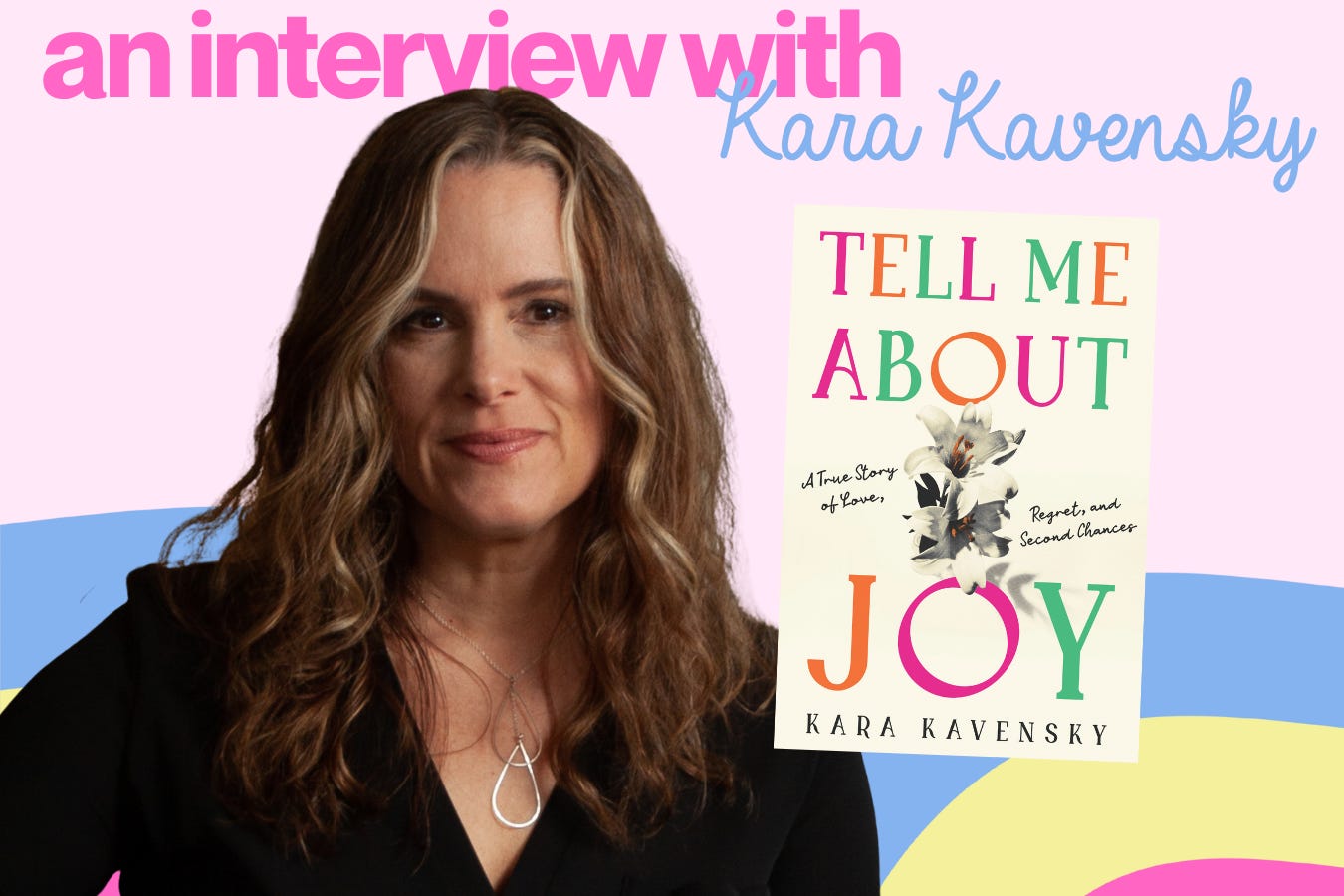
When journalist Kara Kavensky sits down to interview Bob, a World War II veteran, she expects a straightforward human interest story. Instead, Bob tells her about the one who got away — a woman named Joy he'd loved and lost decades earlier — and Kara finds herself on a mission to track her down and reunite them, nearly 70 years later. TELL ME ABOUT JOY weaves that quest together with Kara's own unraveling: her marriage is falling apart amid patterns of narcissism and toxicity, and Bob and Joy's story becomes the mirror that helps her recognize her own. It's a book that's ultimately about second chances on both fronts, the historical love story and Kara's own reclamation.

1. Tell us about your publication journey.
I went the traditional route: I have a lit agent, Katharine Sands, at the Sarah Jane Freymann Agency, and a book deal with Sourcebooks.
My memoir, TELL ME ABOUT JOY, was inspired by an interview that I had with a WWII Veteran named Bob, who sent me on the journey of a lifetime. During an interview for a cover story that I was writing on him, Bob confessed that he had missed out on marrying the love of his life and that he needed (me) to find her so that he could ask her for forgiveness. Her name is Joy.
It’s been thirteen years since I first met Bob. For years, I was still living the story, so I did not write my memoir until much later. Life happens, and while I had my agent for four years before I had a publishing deal, I wasn’t ready. This was mainly due to my youngest son, Jake, dying in a car accident. He was 16. I needed time to grieve and to get my voice back. Once I was ready to pursue a publisher, everything happened rather quickly.
I was determined to share the story of Bob and Joy, and my story is integral to theirs.
2. What has surprised you most about this journey and/or writing your memoir?
When I began my writing process, initially, I did not consider my book to be a memoir. Only after my friend, Betsy Blankenbaker Murphy, asked, “Where’s your story? There’s no ‘Bob and Joy’ with you.” Then she followed up with, “You can help people.”
I knew that she was right. Betsy knew what I was going through (an ugly divorce) and once I could create my own safe space, I began to incorporate my story. First, I was writing in third person, then I eased into first person. I did a ton of structural research before I settled on how my memoir is now formatted — including writing it like a screenplay, only with more detail.
Writing is always therapeutic, and having undergone such intense therapy for healing from PTSD. Writing was a component of my healing process. Therapy is, and will always be, my answer for self-preservation while writing about the tough stuff. Someone’s story is 100% theirs — so we are free to write about interactions with others.
If someone wanted to be presented as kind, they should behave that way. Also, it doesn’t hurt that I have a photographic memory.
3. What’s the one scene a reader would still be thinking about a week after finishing your book?
This is a great question, and should be answered by a reader. Having lived my story, it is challenging for me to answer this. I might say (without a spoiler) that it’s the miracle of me reuniting Bob and Joy. Healing from narcissistic abuse is possible, and it’s never too late for love.
4. Who is this book for?
My story resonates with people who have ever wondered, “What if.” What if we made different life choices? Is it too late to course-correct? I dedicate my memoir to those who want to believe in love and miracles.
5. What part of the story has gotten easier or harder to talk about since publication?
My children’s inclusion within these pages, however limited, is challenging for me to speak about — especially my son, Jake. He died in a car accident 4.5 years ago when he was sixteen, and he’s very much alive within the pages of my memoir.
6. What other books would sit next to yours on a shelf?
According to my publisher, my editor, my agent, and others who have read my memoir, TELL ME ABOUT JOY is next to EAT PRAY LOVE, TUESDAYS WITH MORRIE, UNTAMED, and THE BOOK of CHARLIE. There are others, but those are the ones that most people immediately mention.
No one else covers a transformational journey of healing while providing an example of a loving relationship.

7. In one sentence, why does this need to be a book instead of an essay, a blog, or something they tell their therapist?
The complexity of my personal journey is impossible to quantify in a single essay, especially given the cast of characters within my memoir and the journey that each of them experiences.
8. Looking back, what do you think the book actually did for you — separate from what you hope it does for readers?
TELL ME ABOUT JOY is, in part, my love letter to Bob and Joy. I hope they are proud of me.

Rapid Fire:
1. What are you reading? WHISTLER
2. Watching? Ted Lasso
3. Listening to? Lately, I’ve leaned into nostalgia for 80s music.
4. What’s your favorite book to re-read? THE THIRTEENTH TALE by Diane Setterfield
5. What memoir has been most inspiring to you? REPLACEMENT CHILD by Judy L Mandel
6. What’s your favorite word? Love.
7. How do you stay hopeful? I stay hopeful by focusing on what I am grateful for.
6. Babes in Bookland Q jar: What’s a belief you quietly retired without making a big announcement? I let go of thinking that publishing my first memoir (there are more, and many more books in my queue) at the age of 55 was too late. I’m just getting warmed up.
7. How can we find you?
IG | Threads: @karakavensky
Substack: Finding Joy with Kara Kavensky | karakavensky.Substack.com karakavensky.com
TellMeAboutJoy.com
(this interview may have been edited for clarity)
In case you missed all the links above, you can purchase Kara’s memoir here!
Thank you, Kara!
I’m curious— what’s the best way your life has surprised you? Drop a comment and let me know!
xx, Alex
p.s. Please tap that heart icon and share this with a friend! It helps so much!
p.p.s. Here’s a sweet video of Bob and Joy’s wedding!
Written like a screenplay? Now I have to read this memoir! Sounds intriguing.